The 17% Problem: Why Sales Needs "Production Observability"

Here is the stat that should reshape your entire GTM strategy: buyers now spend only 17% of their buying journey actually talking to potential suppliers.
The other 83%? They are doing their own research—and now, they are armed with AI.
They are using ChatGPT to compare feature sets. Asking Perplexity to surface red flags in your reviews. Using Claude to summarize your documentation against a competitor’s.
By the time they finally agree to a call, they have:
- Narrowed their shortlist.
- Developed strong opinions about your product.
- Done more research in two hours than a buyer could do in two weeks just a few years ago.
Here is the harsh reality: The buyer doesn’t need you for information anymore. They need you for trust. And you have a very narrow window to build it.
Treat the Sales Call Like a Production Environment
Engineers don’t deploy code and "hope for the best." They have observability. They have real-time dashboards. If a system starts throwing errors, they know instantly—not three weeks later in a post-mortem.
Why? Because "production" is where value is created or destroyed.
In sales, the call is your production environment.
Yet, most organizations treat sales calls like a black box. We wait until the deal is lost (the system crashes) to try and figure out what went wrong.
If you only have 17% of the buyer’s attention, you cannot afford to wait for a manager’s call review on Friday to fix a mistake made on Tuesday. You need the ability to detect and fix issues while the buyer is still on the line.
What "Sales Observability" Actually Looks Like
In an engineering context, you monitor for latency or downtime. In a sales context, you need to monitor for friction and disconnection.
Because the buyer is already armed with AI-generated facts, the deal is rarely lost on features. It is lost on rapport, confidence, and trust.
Real-time visibility means knowing, in the moment:
- When trust dips: Not just that a competitor was mentioned, but that the mention caused a drop in confidence.
- When the room is lost: Not just that you are talking 80% of the time, but that the prospect’s engagement has flatlined.
- When a question is a trap: Identifying when a pricing objection is actually masking a lack of belief in the solution.
The Cost of Latency
Consider two scenarios:
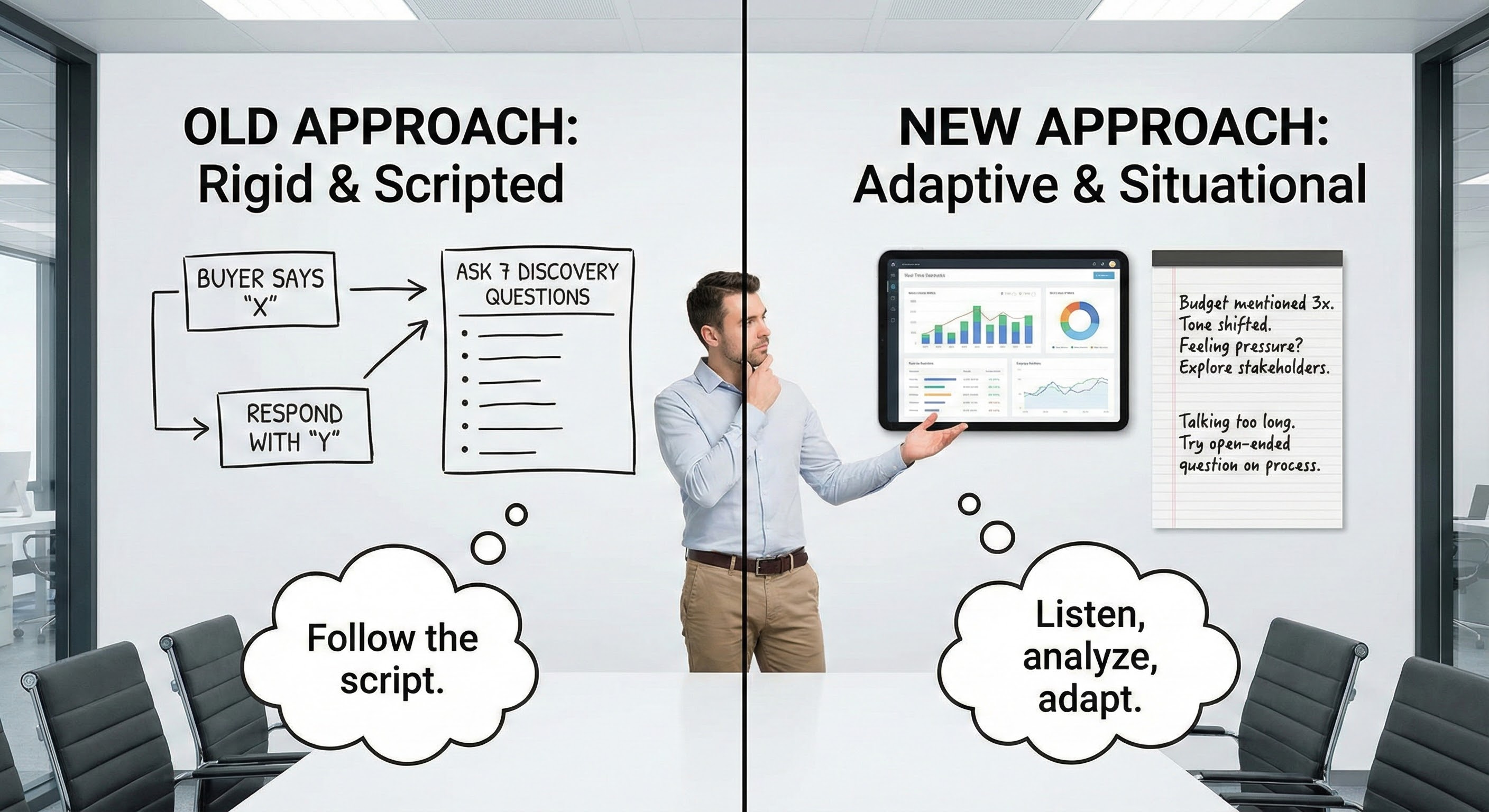
The Traditional Approach (High Latency):
- Monday: Rep misses a subtle signal of hesitation during the demo.
- Friday: Manager listens to the recording and spots the missed objection.
- Next Monday: Rep tries to address it via email, but the momentum is gone.
- Result: Deal lost.
The "Production" Approach (Zero Latency):
- Monday: The system flags a drop in rapport during the call.
- The Pivot: The rep pauses, acknowledges the tension, and re-engages the prospect immediately.
- Result: The objection is resolved in real-time. The trust is preserved.
We Have Lower Standards for Revenue Than for Code
We have had real-time monitoring in engineering for a decade. A VP of Engineering who shipped code without observability would be fired for recklessness.
Yet in sales—where we are fighting for that sliver of 17% against AI-empowered buyers—we are still flying blind. We are still relying on memory, intuition, and lagging indicators. It is time to upgrade.
Your buyers have already moved on. They are using AI to buy faster and smarter. They expect you to meet them there.
Stop doing post-mortems on lost revenue. Start monitoring deals in real-time.